Undergraduate Students Deliver New Translation of 13th-Century Medieval Drama
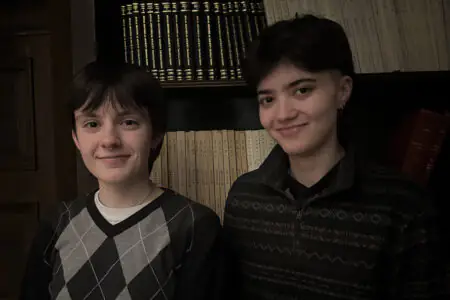
Two Medieval Studies students have created a splash with their translation of a 13th-century Biblical-miracle play, a work they hope to see published soon.
Meagan Mellor and Lauren Saxberg were studying the play La Seinte Resurreccion, which is believed to date back to about 1255, when they determined the translation was problematic. Written in Anglo-Norman, a dialect of Old Norman that was in use from 11th to the 15th century in England, Ireland and Wales, the play details the passion of Christ. It survives today as a fragment of about 360 lines, detailing the passion of Christ, although the title does suggest the original dealt with the resurrection as well.
Meagan and Lauren “felt that the translation used in Professor Matthew Sergi’s ENG330: Medieval Drama was flawed and decided to work with the original manuscripts to produce something better,” explains Professor Alison More, who holds the Comper Professorship in Medieval Studies at the University of St. Michael’s College. The last professional translation was David Bevington’s edition in 1975.
Determined to do the work justice, the two students took on an independent study course with Professor Matthew Sergi, of the University of Toronto’s English Department, to improve on the manuscript. At the end of the fall semester Lauren and Meagan oversaw a reading of their translation in the Medieval World Drama Working Group.
Part of the challenge of the flawed translation likely rests with the scribe who copied down the fragment the students have examined.
“It’s a mess!,” Lauren says of the version they are working with. “The scribe did a terrible job. We think it’s a copy.”
The manuscript the students are working with to create an improved translation resides at the Bibliothèque nationale de France in Paris. While there is another copy of the manuscript at the British Library, they were unable to access it. Lauren notes that being unable to cross-reference the work placed additional emphasis on the skills they had learned in Professor More’s MST358: Medieval Book
Noting that they text they were examining is “very dry,” Meagan explains that, as translators, they tried to return to the tone of the era’s liturgical drama. “While they were performed in a religious setting, medieval performances were not boring,” she says, adding that medieval plays were often known to include an earthy, flippant, and at even bawdy, tone, celebrating the human experience, a reality they hope is better reflected in their translation of secondary characters in the play.
The process of re-translating the fragment meant “stripping it down to the bare bones,” says Lauren.
The two were conscious of looking for the “same syllabic metre and verbal flow” as found in other plays of the era written in Anglo Norman, a dialect that is not as well known as others of that vintage, says Meagan.
While the two students are members of New College, their dedication to the Middle Ages – Meagan is an English specialist and medieval studies major while Lauren is an English and religion major with a minor in medieval studies – the translation process meant spending a great deal of time at St. Mike’s, which sponsors the Medieval Studies program.
“I’d never spent so long on a course,” says Lauren, who cites the “great resource” of the Pontifical Institute of Mediaeval Studies’ library on the fourth floor of the John M. Kelly Library, as well as the ongoing encouragement of Professor More, who helped translate previously untranslated Latin additions to the manuscript, and Professor Emerita Ann Hutchison of PIMS, who was an “enthusiastic supporter,” including pointing out the project to others who might offer help and inviting the students to the teas she hosts at PIMS, the translators add.
Now the students are focussed on preparing their translation for publication, a truly impressive accomplishment for two undergraduates. Hosted by Professor Sergi, the read-through at the Medieval was received enthusiastically, with Professor More and Professor Rita Copeland reading the parts of two of the soldiers.
Recently, Meagan, who is the co-president of the Medieval Studies Undergraduate Society, participated in the two-day Medieval Women Workshop: Authority and Observance at PIMS, presenting on women players in Chester’s mediaeval Drama, and Meagan and Lauren will present their current research at St. Mike’s Undergraduate Research Colloquium, which runs March 5 and 6 in the Kelly Library.
Lauren, who plans to continue graduate studies focused on medieval religious literature, and Meagan, who plans to pursue graduate studies in medieval literature and manuscript culture, say one of the many reasons they have enjoyed their work in medieval studies is that the period is nothing like many preconceptions, and that the relatively small academic field is populated with people who are passionate about attention to detail.
It is also, Meagan notes, a field that has not yet been heavily influenced by artificial intelligence, which makes their hands-on work in translation especially important.