InsightOut: Walking an Interfaith Buddhist Journey Together

InsightOut

Rory Tasker became a Buddhist monk in 2004 and completed the Lotsawa Rinchen Zangpo Translator Program in 2010. Since 2011, he has translated Buddhist teachings for Geshe Sonam Ngodrup and several other Tibetan teachers. He currently serves in this capacity at Lama Yeshe Ling Buddhist Centre in Burlington, Ontario. He completed an MA in Buddhist studies at McMaster University in 2021 and had his doctoral dissertation accepted at the University of Toronto, OISE in November 2025.


By openness to Buddhism, to Hinduism, and to these great Asian traditions, we stand a wonderful chance of learning more about the potentiality of our own traditions.

— Thomas Merton

Teaching “Introduction to Buddhism” for the University of St. Michael’s College Continuing Education’s Interfaith Diploma program was a rewarding learning journey. In my role as a Buddhist monk and translator of Buddhist teachings since 2011, I sometimes forget that much of Canada remains unfamiliar with the spiritual tradition that permeates my everyday life. Sharing my knowledge of the dharma teachings as part of the Interfaith Diploma program provided the opportunity to engage with a new audience and develop fresh pedagogical strategies and perspectives.

“In the beginner’s mind there are many possibilities. But in the expert’s mind there are few.”

—  Shunryu Suzuki

Developing a continuing education survey course on Buddhism from the ground up, looking at the tradition through an interfaith lens, and curating materials that would provide a bird’s eye view of the complexities of the dharma’s various expressions required me to cultivate a “beginner’s mind.” The freshness and curiosity of this beginner’s mind facilitated the creation of a learning environment that invited reflections from a multi-faith audience.

Before each class, I reminded myself that even though I might have some understanding of the doctrines I would be presenting in class, the measure of success of the course was not what I understood, but my capacity to convey those ideas to learners in a compelling and relatable way. Course materials had to be rigorous but relevant – not like the theory-heavy lectures I was used to from graduate school. While my lectures and Power Point presentations were important components of each session, videos, meditations, and especially group discussions were also key to the learning experience. The goal here was not only to introduce the basics of Buddhist philosophy in the course, but to convey how that philosophy was lived in its various expressions across diverse Asian societies. Multiple learning modalities were required to accomplish this.

The open structure of USMC’s course guidelines helped reduce any over-separation between the instructors and learners. This facilitated an environment where the participants were able to steer the conversations and became co-creators of the material, allowing me to adapt lectures according to their interests. This honored the overarching teaching strategy of the Buddhist tradition itself, skillful means – a built-in flexibility that allows engagement from diverse types of people. The Buddha exhorted one of his chief disciples Śāriputra to “know the different aspirations, thoughts and natures of beings,” and I took this exhortation as a personal instruction.

As we built personal connections in our course community each week, an un-rigid attitude to learning emerged that allowed for mutual reinforcement and recognition. The perspectives learners brought from their own traditions enhanced our discussions, and through their eyes I came to a new appreciation of facets of the Buddhist tradition that had faded from my attention.

By the end of the course, even the more introverted participants were sharing personal reflections, particularly regarding their attempts to utilize Buddhist meditation and mind training in daily life situations, such as caring for an ill spouse or navigating difficult interactions at work.

As I look back on this experience, I envision incorporating even more co-collaboration if I am lucky enough to give the course again, emphasizing meditative exercises with immediate applications to daily problems and stories from key figures in the different Buddhist traditions.

The reflective and open-minded approach participants took to learning was an unexpected highlight of this experience. In a space of collaborative curiosity, people from diverse ages, backgrounds, and academic experiences can discover what is possible. I am deeply grateful to USMC Continuing Education for providing this space to come together. In a time when the world is becoming increasingly polarized, learning about each other’s differences in a spirit of openness is more important than ever.

We invite you to learn more about St. Michael’s many Continuing Education courses.


Read other InsightOut posts.

Lisa Samuel is a first-year student at St. Michael’s College here at the University of Toronto, studying Life Sciences. As she settles in at the college, she has become a member of the Arts Committee of the St. Mike’s Students Union, and is an active participant in Dean’s Cup and SMC Intramurals.


Although I was born in Toronto, I was raised in Calgary, Alberta and my backyard view consisted of lush trees and the Rocky Mountains. Now, experiencing the busy city as a semi-grown adult, I have had to acclimate both as a fresh university student as well as a new Toronto resident.

One of the various reasons that informed my decision to come to U of T was the exciting nightlife, and going to the mall or trying a new restaurant every now and then has definitely made the transition a lot easier. However, most of my time at university so far has been spent walking between classes, or staying near residence in order to go to the Canada Room, just in case I get hungry. Because I spend a lot of time at St. Mike’s, I have grown to love certain aspects of the college. Whether it be studying with some other first-year friends in the COOP late at night or attending the events planned by the St. Mike’s Student Union, the college has provided me with many opportunities to network and find a good support system.

Since I was coming from another province, one of my biggest fears of stepping onto such a large campus was having to find a new group of friends. Although orientation week was a great start to get to know people, St. Mike’s also provided me with so many other supports, including events set up through the St. Michael’s College Student Union (SMCSU). As a member of the Arts Committee, it has been a pleasure to come together with other students to create plans and parties that cater to the college’s diverse population. I have made friends with not only other first years, but I have also been able to connect with upper years. Whether I need to vent about courses, need help navigating the campus, or even want to gossip, I always have someone to turn to.

Of all these opportunities, I have definitely had the most fun attending the Dean’s Cup events at St. Mike’s. Similar to the House Cup in Harry Potter, different residences at the college form a team to compete in various activities, such as Ultimate Frisbee or trivia. Dean’s Cup has been a great way for me to get to know people on my floor, and also relive my days as a kid running wild in a field! Throughout all the competition, one thing always remains: everyone is extremely supportive of each other. As a first-year student, events like these genuinely feel like I am stepping into one big welcoming family.

All in all, I have loved getting settled into St. Mike’s. Before coming to live in the college, I would hear stories from my older sister about the unparalleled school and college spirit at St. Mike’s. Of course I initially thought this was pure advertisement. It was only when I experienced the Canada Room that I truly understood what my sister was trying to show me. The energy of various students sitting together, some of whom were just meeting for the first time, is one of the experiences that I feel lucky to be a part of. In all my nervousness about coming to a new school, and adjusting to the fast-paced nature of university, I have never once doubted that I have a place at St. Mike’s. As I continue to move forward in finding my bearings at St. Mike’s, I am proud that the college has become a home away from home.


Read other InsightOut posts.

Roxanne Wright is the Manager of Program Development & Delivery in Continuing Education at USMC. She’s always interested in talking about CE and hearing your ideas. You can reach her at roxanneb.wright@utoronto.ca.


It can be wildly easy to slide into the Doing of Tasks: important stuff, but stuff nonetheless, fills the day and connective ties weaken (I’m sure nobody reading this can relate). This fall, however, I had the privilege of being fully immersed in profound and relational learning through supporting one of our Continuing Education courses, Faith & Food.

Part of the Diploma in Interfaith DialogueFaith & Food was born out of an offhand comment from Prof. Reid Locklin that it might be fun to visit and eat at different places of worship. Thinking that he just might be right, I connected with leaders in Jewish, Ismaili, Catholic, and Mennonite communities who were eager to welcome us. I brought in Dr. Ren Ito to work with leadership in each congregation to create materials to teach learners about their histories and beliefs. We developed a four-week course that brings learners to places of worship to share a meal together, learning about the cultures, customs and traditions of those congregations and faith communities.

At Beth Tzedec synagogue, we tried foods across the Jewish calendar and feasted like it was 5786 on matzah and gefilte fish for Passover, hamantaschen for Purim, apples & honey for Rosh Hashanah, and sufganiyot for Chanukkah. We also tried foods from the Jewish diaspora like babka and bourekas.

At St. Basil’s Church, Lay Pastoral Associate JoAnn Lopez, Father Morgan Rice, CSB, and an amazing group of parishioners served up tacos while we learned about the significance of the ‘table’ in Catholicism, not only in preparing and sharing the Eucharist, but as a place where service and social justice happen.

At the Ismaili Centre, Education Director Rahim Lalji led us through the history of Ismaili Muslims, the traditions of their communities across the world, and how food and communal meals (including one annual meal prepared in their kitchen for approximately 28,000 Toronto Ismailis) unite them. We were treated to samosas, mundu, biryani, and kheer, prepared by volunteers in their beautiful space, and drank chai from a recipe that was perfected in the days when their community met in school gymnasiums.

Our last night was spent with my congregation at the Toronto United Mennonite Church, where we toured the spaces used both by TUMC and the Mennonite New Life Centre, a Spanish congregation that meets on the third floor. We heard about histories and beliefs, culinary evolutions from a European diaspora to a global community, and how cookbooks play a role in sharing traditions that reinforce values of hospitality, simplicity and care for the environment. Best of all, we rolled up our sleeves to make vareniki (cottage cheese dumplings with cream sauce), Nicaraguan rice and black beans, borscht, and Saskatoon berry platz for a meal that was blessed by a traditional grace sung in four-part harmony.

Beyond sharing incredible food, the ways that the hosts and the learners shared their energy was life-giving to me. Our hosts from each site separately remarked how much fun they had getting the chance to reflect on their own faith—why do we do things the way we do? What are the things we take for granted in how we live our beliefs? Their excitement in sharing was visible, and it was a genuine joy to see it.

The biggest cup-filler for me, though, was spending time getting to know the learners. It was a diverse group of people participating for many different reasons, each coming to the class from different places in their own lives. One learner stands out to me: she registered with a long list of dietary restrictions, and I worried that she wouldn’t enjoy the course. Quite the opposite! She came each week, just as vibrant and lively as can be. As I got to know her, I learned about some of the big challenges she pushed through to be able to join us. Her surprising and hope-filled reflection at the end of the experience reminded me to stay curious about the ways that each of us walk our paths: “I suppose there are benefits to my not being able to eat, I can focus more on hospitality and service.”


Read other InsightOut posts.

Prakash Anthony Lohale, OP, is a Dominican friar with a Licentiate in Spirituality from the Angelicum in Rome. His extensive ministry focuses on teaching, justice, and interfaith engagement. He has served in international leadership roles for the Dominican Order in Rome and as the Director for Ecumenism and Interreligious Dialogue for the Archdiocese of Toronto. He remains deeply engaged in interfaith work through several boards and committees. He currently serves as the Social Justice Animator at the Mary Ward Centre and is a sessional instructor at Regis St. Michael’s Faculty of Theology.


In a world increasingly defined by metrics and algorithms, the human person can easily be reduced to a data point. This is perhaps most tragically true for the poor, who are often discussed in terms of statistics, poverty lines, and percentages. Yet, the Catholic Church, through the World Day of the Poor, offers a radical counter-narrative.

Established in 2017 by Pope Francis to perpetuate the spirit of the Jubilee of Mercy, this day challenges the faithful to move from abstraction to encounter, from charity to justice, and from pity to transformative hope. The first and most fundamental step in this mission is a shift in perception. Pope Francis has repeatedly implored us to “set statistics aside,” arguing that “the poor are not statistics to cite when boasting of our works and projects. The poor are persons to be encountered” (Message for the 3rd World Day of the Poor, §9). This aligns with the profound insights of Nobel laureate economist Amartya Sen, who reframed poverty not as mere “lowness of income,” but as a “deprivation of basic capabilities.” Poverty, in this light, is the crushing of human potential—the restriction of freedom and the stifling of dreams. When we see a person living in poverty, we are not looking at a number, but at a human being whose God-given capacities are being systematically constrained. They are, as Pope Francis writes, “lonely, young and old, to be invited to our homes to share a meal; men women and children who look for a friendly word” (Message, 3rd WDP, §9).

While providing material aid—food, clothing, shelter—is a necessary and urgent work of mercy, the Church calls us to something deeper. The ultimate need of the human heart is not met by a transaction, but by relationship. Pope Francis clarifies that while the poor come to us for food, “what they really need is more than our offer of a warm meal or a sandwich. The poor need our hands, to be lifted up; our hearts, to feel anew the warmth of affection; our presence, to overcome loneliness. In a word, they need love” (Message, 3rd WDP, §9). This echoes the experiences of countless ministers, like Deacon Robert Kinghorn of “Church on the Street,” who observed that beyond physical necessities, the poor deeply crave friendship, a listening ear, and a sense of belonging. This fundamental need to be accepted and heard is the bridge that connects all humanity, calling us beyond mere charity to genuine solidarity.

This mission is rooted not in sociology, but in Christology. The Church’s preferential option for the poor is founded on the startling truth of the Incarnation. As articulated by Pope Leo XIV in his recent exhortation, In Dilexi te (“I have loved you”), “Christ himself became poor, and that therefore we can see Christ in all those who are poor in our world today.” This is the lens through which figures like Saint Mother Teresa operated. Seeing the words “I thirst” beside the crucifix in her chapels, she and her sisters served the destitute and dying with the conviction that in tending to the wounds of the poorest of the poor, they were literally tending to the wounds of Christ Himself. This perspective transforms service from an act of pity into an act of worship and communion.

Furthermore, Pope Leo XIV expands this concept by presenting the poor not merely as passive recipients of aid, but as “protagonists of hope” (Message for the 9th World Day of the Poor). Their hope, forged in the crucible of suffering and rooted in God, stands as a powerful witness to the world. He urges us to “be particularly attentive to those who are most marginalised in our society and listen to the wisdom that only they can offer” (In Dilexi te). By their lives and their faith, the poor challenge our complacency and put us in contact with the stark truth of the Gospel.

The logical conclusion of this theology is a call to action that addresses both immediate need and root causes. Personal encounter must be coupled with a commitment to justice. Pope Leo XIV emphasizes that “poverty has structural causes that must be addressed and eliminated” (Message, 9th WDP). He explicitly calls for the development of policies to combat poverty and champions the role of institutions like hospitals, schools, and shelters as “effective signs of hope.”

This work inevitably requires a prophetic voice. Pope Leo boldly states the “need for us to raise our voices to call for an end to unjust structures and systems which keep people poor, even if others consider us foolish or naïve” (In Dilexi te). This echoes the ancient wisdom of St. Augustine, who noted, “You give bread to a hungry person; but it would be better if none were hungry so that you would have no need to give it” (In Iohannis Evangelium Tractatus, 8, 5). Helping the poor is a matter of justice before it is a question of charity.

Jesus’s statement, “The poor you will always have with you” (Matthew 26:11), has often been misconstrued as passive acceptance. The World Day of the Poor reframes it as a poignant, personal question for every Christian and every community: “The poor are always with us. But are we with the poor?”

The challenge is clear. We are called to be a “Church on the Street,” ensuring that when our brothers and sisters in need knock on the doors of our hearts and our communities, they find not just aid, but a true welcome. They must find a place where they belong, where their hope is nourished, and where their God-given dignity is affirmed. In answering this call, we do not simply offer hope to the poor; we encounter the hope they embody—the hope of Christ, who in becoming poor, forever enriched the world.


Prakash Anthony Lohale, OP, is a Dominican friar with a Licentiate in Spirituality from the Angelicum in Rome. His extensive ministry focuses on teaching, justice, and interfaith engagement. He has served in international leadership roles for the Dominican Order in Rome and as the Director for Ecumenism and Interreligious Dialogue for the Archdiocese of Toronto. He remains deeply engaged in interfaith work through several boards and committees. He currently serves as the Social Justice Animator at the Mary Ward Centre and is a sessional instructor at Regis St. Michael’s Faculty of Theology.


In a world increasingly defined by metrics and algorithms, the human person can easily be reduced to a data point. This is perhaps most tragically true for the poor, who are often discussed in terms of statistics, poverty lines, and percentages. Yet, the Catholic Church, through the World Day of the Poor, offers a radical counter-narrative.

Established in 2017 by Pope Francis to perpetuate the spirit of the Jubilee of Mercy, this day challenges the faithful to move from abstraction to encounter, from charity to justice, and from pity to transformative hope. The first and most fundamental step in this mission is a shift in perception. Pope Francis has repeatedly implored us to “set statistics aside,” arguing that “the poor are not statistics to cite when boasting of our works and projects. The poor are persons to be encountered” (Message for the 3rd World Day of the Poor, §9). This aligns with the profound insights of Nobel laureate economist Amartya Sen, who reframed poverty not as mere “lowness of income,” but as a “deprivation of basic capabilities.” Poverty, in this light, is the crushing of human potential—the restriction of freedom and the stifling of dreams. When we see a person living in poverty, we are not looking at a number, but at a human being whose God-given capacities are being systematically constrained. They are, as Pope Francis writes, “lonely, young and old, to be invited to our homes to share a meal; men women and children who look for a friendly word” (Message, 3rd WDP, §9).

While providing material aid—food, clothing, shelter—is a necessary and urgent work of mercy, the Church calls us to something deeper. The ultimate need of the human heart is not met by a transaction, but by relationship. Pope Francis clarifies that while the poor come to us for food, “what they really need is more than our offer of a warm meal or a sandwich. The poor need our hands, to be lifted up; our hearts, to feel anew the warmth of affection; our presence, to overcome loneliness. In a word, they need love” (Message, 3rd WDP, §9). This echoes the experiences of countless ministers, like Deacon Robert Kinghorn of “Church on the Street,” who observed that beyond physical necessities, the poor deeply crave friendship, a listening ear, and a sense of belonging. This fundamental need to be accepted and heard is the bridge that connects all humanity, calling us beyond mere charity to genuine solidarity.

This mission is rooted not in sociology, but in Christology. The Church’s preferential option for the poor is founded on the startling truth of the Incarnation. As articulated by Pope Leo XIV in his recent exhortation, In Dilexi te (“I have loved you”), “Christ himself became poor, and that therefore we can see Christ in all those who are poor in our world today.” This is the lens through which figures like Saint Mother Teresa operated. Seeing the words “I thirst” beside the crucifix in her chapels, she and her sisters served the destitute and dying with the conviction that in tending to the wounds of the poorest of the poor, they were literally tending to the wounds of Christ Himself. This perspective transforms service from an act of pity into an act of worship and communion.

Furthermore, Pope Leo XIV expands this concept by presenting the poor not merely as passive recipients of aid, but as “protagonists of hope” (Message for the 9th World Day of the Poor). Their hope, forged in the crucible of suffering and rooted in God, stands as a powerful witness to the world. He urges us to “be particularly attentive to those who are most marginalised in our society and listen to the wisdom that only they can offer” (In Dilexi te). By their lives and their faith, the poor challenge our complacency and put us in contact with the stark truth of the Gospel.

The logical conclusion of this theology is a call to action that addresses both immediate need and root causes. Personal encounter must be coupled with a commitment to justice. Pope Leo XIV emphasizes that “poverty has structural causes that must be addressed and eliminated” (Message, 9th WDP). He explicitly calls for the development of policies to combat poverty and champions the role of institutions like hospitals, schools, and shelters as “effective signs of hope.”

This work inevitably requires a prophetic voice. Pope Leo boldly states the “need for us to raise our voices to call for an end to unjust structures and systems which keep people poor, even if others consider us foolish or naïve” (In Dilexi te). This echoes the ancient wisdom of St. Augustine, who noted, “You give bread to a hungry person; but it would be better if none were hungry so that you would have no need to give it” (In Iohannis Evangelium Tractatus, 8, 5). Helping the poor is a matter of justice before it is a question of charity.

Jesus’s statement, “The poor you will always have with you” (Matthew 26:11), has often been misconstrued as passive acceptance. The World Day of the Poor reframes it as a poignant, personal question for every Christian and every community: “The poor are always with us. But are we with the poor?”

The challenge is clear. We are called to be a “Church on the Street,” ensuring that when our brothers and sisters in need knock on the doors of our hearts and our communities, they find not just aid, but a true welcome. They must find a place where they belong, where their hope is nourished, and where their God-given dignity is affirmed. In answering this call, we do not simply offer hope to the poor; we encounter the hope they embody—the hope of Christ, who in becoming poor, forever enriched the world.


Read other InsightOut posts.
Professor Jaroslav Skira is the Fr. Terrance Forestell, CSB, Dean of the Regis St. Michael’s Faculty of Theology (Toronto School of Theology.) He is a Fellow of the Metropolitan Andrey Sheptytsky Institute of Eastern Christian Studies, and Associate Professor, Centre for European and Eurasian Studies at the Munk School of Global Affairs & Public Policy (University of Toronto).


I went to a war zone – to Ukraine. Russia started an unjust war there.

I was in Ukraine 35 years ago, before the fall of the Soviet Union. What I saw then was a deplorable system of totalitarianism. No freedom of religion; no freedom of conscience; no solicitude. Today that same reality exists in Russian-occupied regions of Ukraine.

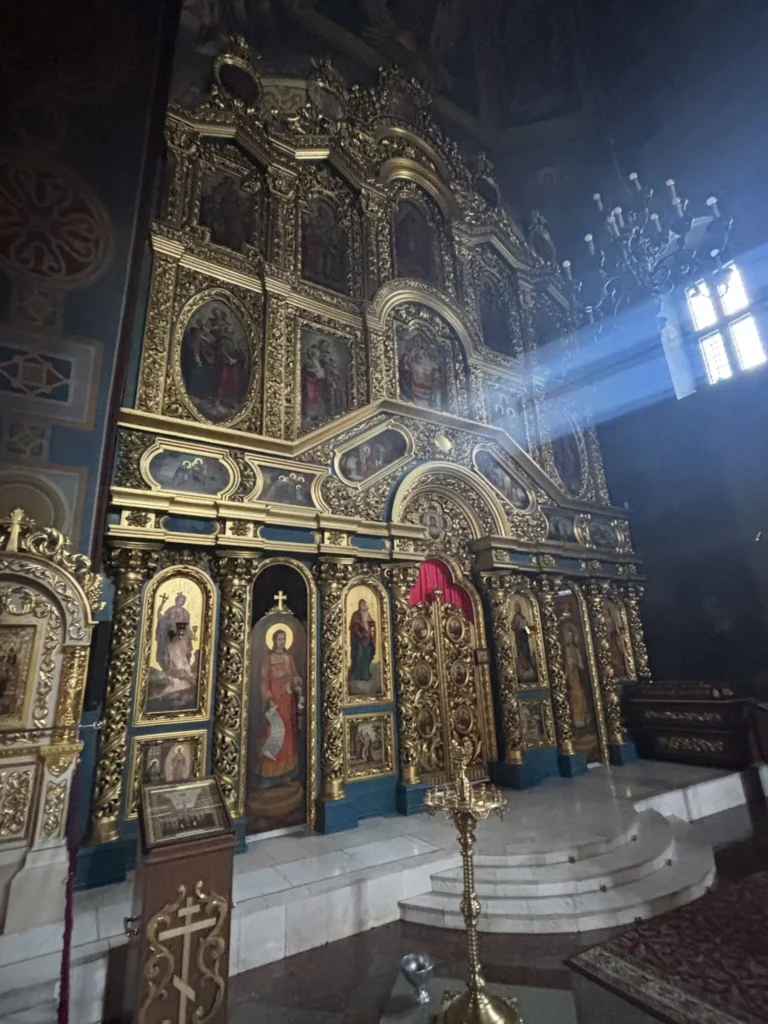
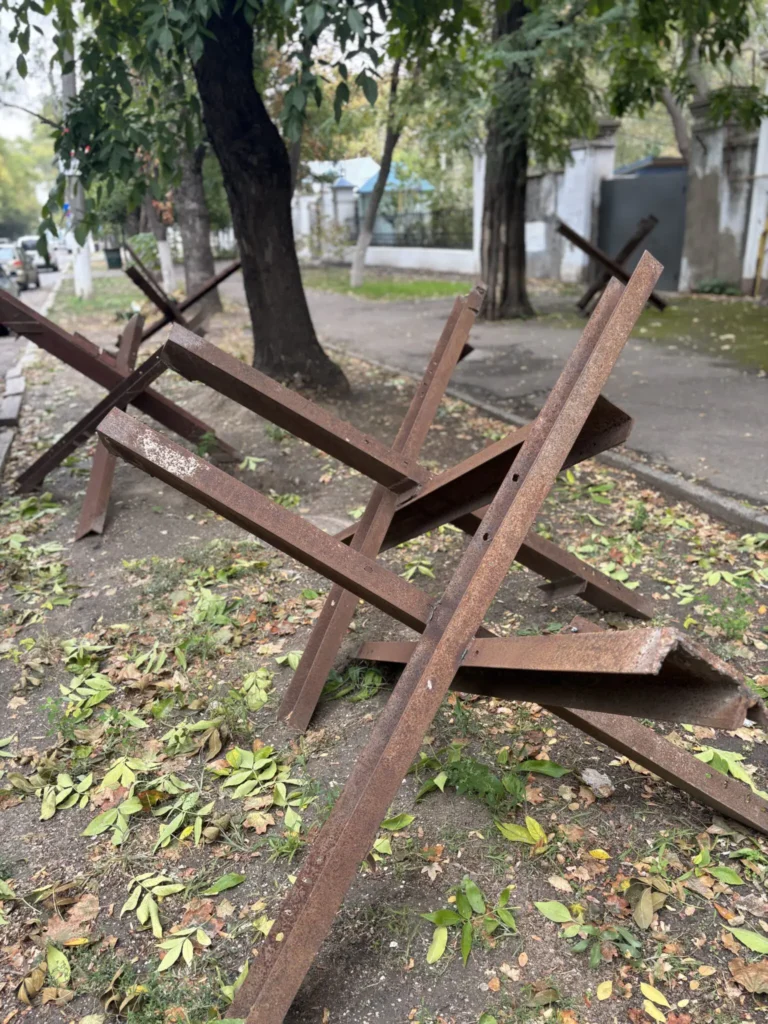
On this trip, though, what I saw were beautiful Ukrainian cities and villages. I saw a country maturing into a modern democracy. In the main square of the major city of L’viv, where three decades ago I saw a statue of a  communist mass murderer, this time I saw public spaces filled with groups of happy young people seemingly oblivious to the reality of the war. But the reality of war was there. I saw historic monuments and buildings surrounded by sandbags. I saw centuries-old churches with windows boarded up and museums hiding their invaluable collections in storage as protection from missile strikes.

It was back in 1990, on my first trip, that I met my paternal grandmother and aunt, even before my dad had ever come to know them. Take that in – my dad had never really known his mother and sister. In his infancy, at the end of World War II, he was separated from this family when the Soviet Union gobbled up much of Eastern Europe and forcibly re-settled this closest of families to southern Ukraine. (He finally met his mother and sister a few years later). On this trip I would once again visit his surviving sister – my aunt.

People asked me if I was scared to go to Ukraine, if I felt I was in any danger, or what my wife thought of me going there. Going to Ukraine, to a war zone, was exactly what I expected … well, almost. I think I was prepared for being woken up at night to the sound of air-raid sirens; for sleep depravity. I was prepared for difficulty travelling, for blackouts, for the cold.

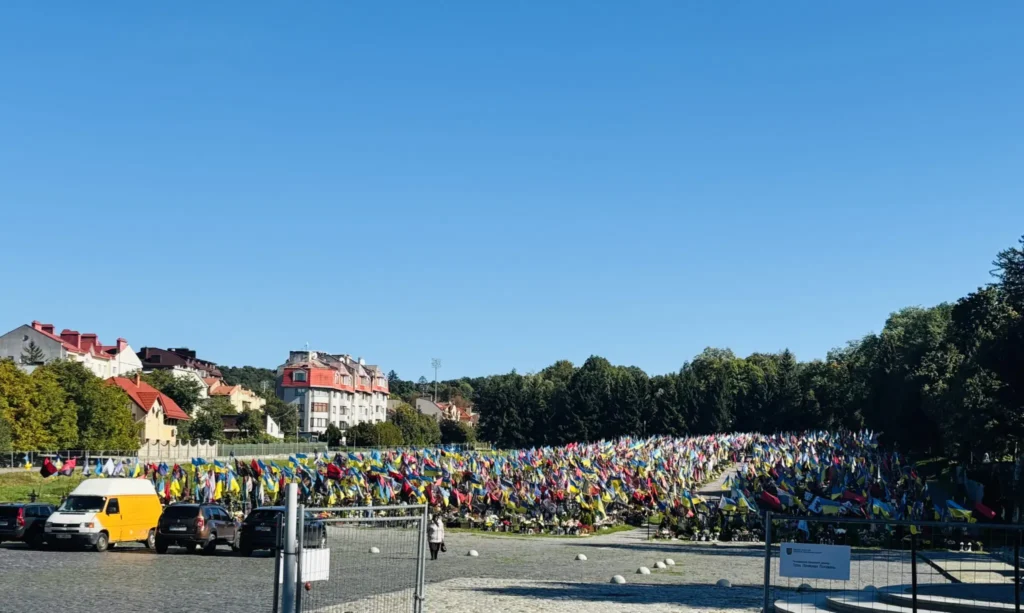
But the one thing that I wasn’t quite prepared for was seeing the prevalence of so much grief and trauma – and yet resilience. Everywhere I went, I saw memorials to soldiers – women and men – killed in action, prisoners of war, or missing in action. I heard stories of terrible deaths due to Russia’s brutal war on Ukraine. My eyes welled up with tears when I heard these stories. They still do so today – right now, in fact, as I write.

One of the most difficult and emotionally painful parts of my trip was visiting a famous cemetery in L’viv (western Ukraine) with a family member. This was her first visit there. I soon found out why she hadn’t visited before. She lay flowers at the graves of two young soldiers she knew well. It had been too painful for her to come here before.

I, too, bought some flowers to pay my respects, not knowing where I would place them. It was there that a mother came up to me and asked me if I ‘had anyone there.’ Her soft words betrayed a mother’s deep grief of the loss of a son, of wanting to embrace him one more time, of the lament of not being able to play with grandchildren that she might have had. His grave was very fresh. She had waited a year for news about him. They had to identify him by DNA. All I could offer was a hug and a promise of a prayer. I asked her if I could lay my flowers at his grave. His name was Roman. As I write – my eyes again are welling-up with tears.

As I sat with family, friends, and even strangers, I asked how they were doing under the war.  I was repeatedly amazed by their resilience. Despite the war, despite the trauma and fear of death, they continued to live, to work, to love and to hope for joy and peace to return. Not a single person wanted the ‘Russian world’ to come to them.

I tried to stay in places where I thought Russians wouldn’t strike – American hotels with bomb shelters, near embassies, or near major Christian religious sites so necessary for Russia’s delusional imperial mythology. Ukraine has a remarkable air-defence system, with an air-raid warning app. And yes, I did hear explosions and anti-aircraft fire.

I went to a war zone hoping I could do some good, perhaps some modest acts of kindness. If only for a moment, could I bring some joy? or perhaps a warm smile to help forget the war? or, even just simply to listen? I didn’t want to be like those servants in that biblical parable condemned for not sharing their gifts.

Part of my trip was to participate in an event organized by the Ukrainian Greco-Catholic Synod of Bishops. Ukrainian Eastern Catholic theologians and formators gathered to reflect on contemporary challenges in theology and ministry. I went as an invited delegate from the Metropolitan Andrey Sheptytsky Institute of Eastern Christian Studies to discuss how Ukrainian universities, colleges, and seminaries could collaborate, especially in these terrible times of war. I also brought messages of solidarity from our Regis St. Michael’s Faculty of Theology and Toronto School of Theology colleagues, telling our friends in Ukraine that we prayed weekly for peace. My plenary address was in a bomb shelter at the Ukrainian Catholic University in L’viv.

To make the most of my trip, I also went to Ukraine’s capital Kyiv, where I met with colleagues from seminaries, theological schools and universities. Here the goal was the same – messages of solidarity, perhaps enjoying moments of levity and joy, and wanting to be present to colleagues and students.

My train to Kyiv passed through Bucha and Irpin, places of the most savage cruelty and depraved violence of Russian soldiers against a civilian population. Images of dead bodies littering the streets are forever etched into my memory. Social media has brought the war, unfiltered, all too painfully close to the world. That kind of evil violence cannot be unseen.

My last stop was to see my aunt and family. I travelled to the outskirts of the southern city of Mykolaiv, about an hour away from the front lines. When I told them I was visiting Ukraine, they were overjoyed – my aunt even said she had a premonition that there would be good news that day. I initially asked whether it was possible for them to meet me in western Ukraine, a relatively safer part of the country.

With an octogenarian aunt, travel was difficult. The only way to meet the entire family was to go to them. I couldn’t tell them I couldn’t visit them because of the war – they lived that reality daily! My aunt lived through years of totalitarianism, only recently experiencing a few decades of democratic freedoms. Now in her senior years, she was again experiencing that same violence.

I saw the cellars in which families sheltered during the cold winter months at the start of the war – dirt floors, with no electricity, gas, running water, or washrooms with small cast iron stoves for heat. I saw upfront the damage a Russian missile could do to an eight-story building.  But we laughed, shared stories, and embraced. So, for a moment, there was joy and peace.

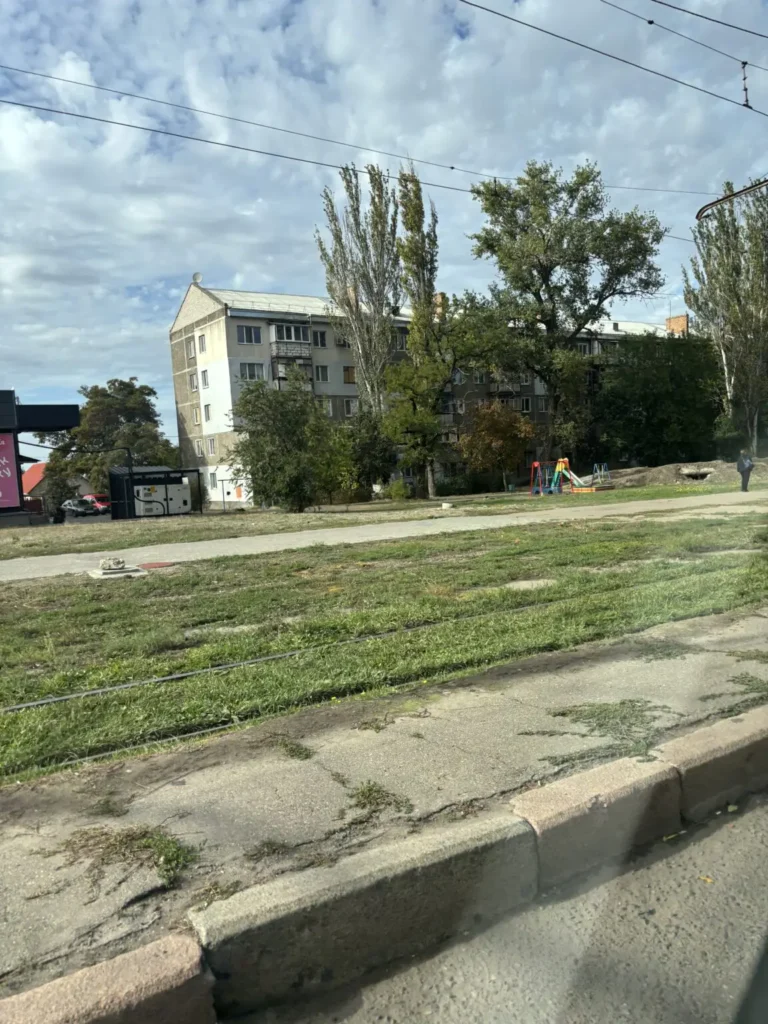
It was surreal to see an army bunker in front of an apartment complex, right next to a children’s playground! What a violation of the innocence of children, to have to be confronted with threats of Russian-state abductions, forced relocations, cultural genocide, and even possible death, supported by a quasi-religious ideology of the Russian Orthodox Church. To those of us in Canada, this should remind us of the horrors of the residential school system’s systemic violence against Indigenous peoples and their children, often perpetrated by the churches. All of this is abhorrent.

On my last night in Ukraine, my air raid app woke me up in the middle of the night. I heard explosions, perhaps anti-aircraft fire or missiles hitting their targets. Those air raid sirens were the eery sounds of approaching death. You hoped that the morning would bring good news, but deep down you knew that tragedy always followed. That day, I saw an announcement from a high school  – their grade 10 student and her entire family were killed. At moments like that, I felt like a Psalmist, praying to God in gratitude for those who got to live another day while, in the same breath, cursing those vile people that brought death our way.

It took me almost four days to get home. First, an 18-hour train ride then a stopover in western Ukraine on the way to a 6-hour drive to a Polish airport for an early morning flight home. You can’t take an airplane within Ukraine, and you have to wait hours and hours to cross borders due to heightened security. I was prepared for this.

I went to a war zone. I know too that I brought some joy and compassion – if only for a few precious moments.


Read other InsightOut posts.

M.C. Havey (SMC 71) graduated with a history degree from the University of Toronto and worked as a news reporter for two Ontario newspapers and The Canadian Press, always on the lookout for the human interest angle in news stories. After a graduate degree in history from the University of Waterloo in 1984, she has worked in archives ever since, initially for the Archives of Ontario. The mutual archivist for the Sisters of Service and the Congregation of the Holy Redeemer (the Redemptorists), M.C. is the recipient of the Alexander Fraser Award from the Archives Association of Ontario, the Francis X Seelos Award from the Institute for the Redemptorist Historical Studies, North America, and the Edward Jackman Award from the Canadian Catholic Historical Association.


I have come full circle in my connection with the John M. Kelly Library. Just after opening in 1969, the library became my undergraduate home as a history student. I read, researched and wrote papers on topics in Canadian, British and American history on the second floor in a row of study carrels along the southern windows overlooking St. Joseph’s College School. The bright interior décor and spaciousness with comfortable seating were conducive to focused long hours to meet deadlines of course readings, papers or exams.

More than five decades later, the area of the second floor carrels now houses the library’s Special Collections, where is located my proudest professional achievement of completing the archives of the religious Institute of the Sisters of Service (SOS) for its donation to the library.

Glimpses of the plucky Sisters are highlighted in the 150-item exhibit: The Big Maps, The Sisters of Service as Canadian Trailblazers, which opens on October 23 at the Kelly Library’s ground level exhibit area. Last year, the 500 boxes of SOS archival records were transferred to the library and contain the documents and images of this untraditional, unique women’s missionary community for Canadians, especially immigrants, from the Toronto founding in 1922 and to the present.

The SOS were a far cry from the sisters who had taught me in separate school and high school. Instead of religious habits, convents and strict rules, the SOS wore simple grey uniforms, stylish capes and hats, and kept their Christian and surnames, all of which broke invisible interpersonal barriers. Living under flexible rules in humble dwellings among the people, they taught in one-room schoolhouses and nursed in their central Alberta hospitals. In spreading and maintaining the faith in rural Canada, the SOS set up religious correspondence schools in Edmonton (1926) and Regina (1934) and mailed catechetical lessons, often accompanied by colouring games, to thousands of students in the winter, many of whom the Sisters met on their summer tours to teach catechism and to prepare the students for First Communion/Confirmation. These quietly competent and confident women were mature, resilient, gritty and innovative, adjusting to their circumstances, whether by driving cars in the late 1920s or accepting government professional positions in the Canadian North in the 1970s.

Over a period of 28 years in the SOS archives, my knowledge and admiration grew when tackling the archival organization and file listing, and later in writing and researching their history for requests, papers at conferences and mounting an archives website. When I began in the SOS archives, more than half of the 124 Sisters were living. My sense of the individual Sisters’ personalities and events emerged initially from the details of their typed or handwritten correspondence and reports, and from articles in their quarterly magazine, The Field at Home. It also came from reading anecdotes of mishaps, joys, changes and fun in the annals, the daily journal of each of the 60 Canadian missions. That sense of familiarity deepened with informal, casual chats with Sisters, who stopped at the archives’ open door, and related cherished anecdotes of people and missions. For eight years, Sister Viola Mossey, who stands in a prairie wheatfield on the left side in the exhibit’s iconic photograph, helped in the archives. Sister Vi reminisced, often with laughter, about family, friends, the SOS, and her missions, especially in the women’s residence, the deaf ministry and parishes. She was a priceless identifier of Sisters, events and locations in photographs.

The 20,000 photographic images taken by, or for the Sisters are the gem of the archives. Hours of listing details of almost each photograph, which were placed on a database, will provide future Kelly Library archivists with easy retrieval of the historically important photographs; images in the 150 albums and 5,000 photographs in individual envelopes with specific information. I still pause in amazement of the effect these photographs in documenting the changes across the country. In an album of the teaching mission in Sinnett, Saskatchewan, Sisters’ photos capture the farming, school and community life of a village that no longer exists and now is recognized solely by a historical plaque. For the exhibit, Kelly Library Archivist Francesca Rousselle selected some favourite photographs. The startling image evokes a smile of founder Catherine Donnelly, spirited at age 50, swinging an axe to clear a rural Cariboo Road in British Columbia during a two-month tour to teach catechism to the ranchers’ children. No doubt, determination was summoned with every swing.

Together, the photos and the printed records also captured Canada grappling with the Depression, prairie drought, wartime rations, postwar immigration and its subsequent boom. In mission correspondence, Sisters note area development through government programs of road construction, the closing of small schools and hospitals in favour of large regional schools and hospitals. I was amazed, specifically, at their detailed accounts and statistics in their reports of meeting and assisting Catholics disembarking from European ships at Halifax’s Pier 21, Quebec City, Montreal and Saint John, NB.

The 1960s were a turning point for the SOS. The original missions of teaching in one-room schoolhouses, small hospitals, women’s residences, and religious education were either closed or adjusted according to societal changes and the renewal of religious life from the Second Vatican Council. Sisters took the opportunity of switching professional careers to meet the people in current need after graduating from universities and technical courses. Further ground-breaking paths lay in the number of Sisters from the late 1960s until the 1990s. Besides Sisters employed in social work and public health, others mounted early childhood education, and university courses for prospective indigenous teachers. Their pastoral care broadened as parish religious educators, administrators and assistants as well as chaplains and nurses in psychiatric and general hospitals, or as the first women chaplain in federal prisons. The walls of the Toronto Motherhouse were covered with plaques of gratitude to individual sisters, and the community for their dedicated service. The SOS financial and spiritual legacy continues to extend the charism and mission with the creation of the Catherine Donnelly Foundation in 2003 to assist nonprofit organizations.

As an archivist, my fretting over the final archives’ location has ended. The archival records as the SOS historical legacy now are part a growing research centre on the second floor of the Kelly Library, nearby where I began my study and appreciation of history. Full circle!


Read other InsightOut posts.

Alberto Di Giovanni was born in Roccamorice, province of Pescara, Abruzzo, Italy, in 1945. He came to Canada to join the rest of his family in 1963. He entered St. Michael’s College for the Western Year in 1966, graduating with an Hons. BA in 1971 and an MA in 1973. He was the founder and Executive Director of Centro Scuola e Cultura Italiana and also the Director of Cultural Activities at the Columbus Centre, 901 Lawrence Ave West. He has received numerous awards, including the Silver Jubilee Medal of Queen Elizabeth II and the Golden Jubilee Medal of the Queen; Educator of the Year from OISE; Italian Olympic Committee medal for sports development ; Dante Society honors as Vice President for North America and President of the Toronto Chapter; Grand Ufficiale della Repubblica d’Italia.

Caroline Morgan Di Giovanni was born in Pittsburgh, Pennsylvania in 1947. She was raised in Havertown, PA, and came to Toronto in 1966 to attend St. Michael’s College. She graduated in 1970 with an Hons BA in English Language and Literature. She went to Tufts University in Massachusetts to earn a Master’s Degree in Drama in 1972. That year she married Alberto Di Giovanni and moved to Toronto permanently. She became a Canadian citizen in 1977. She was elected as a Trustee in the Metropolitan Separate School Board in 1978 and was re-elected several times, serving as Chair of the Board in 1987 and 1988. She also served as a councillor on the Metro Toronto Council until 1998. Other work included the Catholic School Trustees Association and the Catholic Children’s Aid Society.

Caroline edited 2 editions of Italian Canadian Voices: Anthologies of Poetry and Prose (1986 and 2006) and Bravo, an anthology (2012); five books of original poetry, the latest is Personal Mysteries (Mosaic Press, 2025).

The Di Giovannis have 3 children, each now married; there are 4 grandchildren. Both Caroline and Alberto have been named Honorary Fellows of the University of St. Michael’s College.


Caroline Morgan and Alberto Di Giovanni, who established the Dante Lectures, both took courses on the Divina Commedia by Dante Alighieri during their undergraduate years at St. Michael’s College. After their graduations, they married in 1972 and began their professional and family lives in Toronto. They have treasured memories of their days at St. Mike’s and remain proud alumni.

Alberto went on to organize the Canadian Centre for Italian Studies, known universally as Centro Scuola. This not-for-profit organization gained broad support in the Italian Canadian community, creating events to raise awareness of the contribution Italian culture brought to Canadian life. By the mid-1970’s, Centro Scuola was able to bring groups of Ontario secondary school students to Italy to see the original locations of Italian history, art and literature. In partnership with the Toronto Catholic School Board, secondary school teachers accompanied the student groups and taught classes daily to allow the students to earn credits while they were overseas. This combination of study and travel continued for 35 years, in both summer courses and then semester courses. The experience of living in a typical Italian town and also visiting the great cities provided thousands of Ontario students with long lasting impressions and friendships.

During all those years of travel in Italy, giving lectures and meeting with experts in many fields, Alberto developed a special interest in finding editions of Dante’s great works. His visits to antiquarian bookstores often resulted in rare finds to bring back to Toronto. Facsimile editions were also available to add to the growing collection. This meant that the Di Giovanni living room was filling up with bookshelves. Interest in Dante and the interpretation of the cantos in the Divina Commedia became a shared passion for both Alberto and Caroline. Finally, at the time of Alberto’s retirement as Founder and Director of Centro Scuola, an opportunity arose to create something lasting out of this intense interest in Dante’s legacy. A retirement dinner was organized to raise funds for future scholarships and cultural activities. Participation by so many former Centro students and community members was so great that the fundraising exceeded all expectations. As a result, there was agreement to provide scholarships for Centro students and to contribute to Dante studies at the university level, specifically at St. Michael’s College.

Then began a series of meetings between the Advancement Office and Alberto and Caroline. The outcome resulted in two initiatives: one portion of the funds would support annual awards for excellence in the study of Dante and in Italian language; the other would create an endowment for an annual lecture on Dante and aspects of his great masterpiece, the Divina Commedia. The student achievement awards are given every year convocation.

The Dante Lecture has found a place in the fall semester every year, meant to attract a wider audience that includes students and university academics, but also reaches out to alumni who remember learning about this work as literature, and the general public attracted by the continuing presence of Divine Comedy references in our cultural mix. Both Di Giovannis are respectful of the need for scholarly examinations of the text. St. Michael’s, PIMS, and U of T have strong reputations in Medieval Studies and literary history. However, they wanted to invite the guest speakers to make a special outreach to audiences who may not be engaged in pure academics, but who are ready to listen and learn about Dante in a contemporary context. Happily, that has been the case since the first of these Annual Dante Lectures at USMC, in 2017 (of course with the break for the Covid pandemic). The audiences have greeted the lectures with enthusiasm, holding lively discussions at the reception that follows.

The lecture this year is on ‘Dante’s Musical Journey in the Divine Comedy’. It will take place on Friday, October 24, at 6 p.m. in Room 400, Alumni Hall, 121 St. Joseph St.

For more on St. Michael’s Day of Dante, please visit this page.


Read other InsightOut posts.

Paige Mullin is a second-year Christianity & Culture and Book & Media Studies double major. She is a Student Campus Minister at the University of St. Michael’s College and Associate Editor for the Saeculum Academic Undergraduate Journal. She is very excited to share this reflection with the community and hopes you enjoy reading it.


Thanksgiving is a time of gathering as a community. Some people spend this time with family, friends, and sometimes strangers. When my grandfather was alive, he would host the family’s Thanksgiving dinner at his house. Since his passing, the task alternated among his children for the following years. Regardless of whether the dinner was held in our home or six hours away, my father always tells us about the Thanksgiving tradition he grew up with.

My grandfather hated the idea of people in his community going hungry or being alone on Thanksgiving, so each year, he would open his doors to anyone. Neighbours, friends, strangers, people off the street — all gathered to sit at his table as equals. In this way, he built a community on love and service that carried on for years. He began this tradition before he had children and continued it up until his passing in 2022 at the age of 93. Yes, even at that age he made it a point to serve the community. As his children grew up and had families of their own, we would celebrate Thanksgiving a few days prior or after the actual day, so my siblings, cousins, and I never experienced the open-door dinner he would host, but he and his children would tell the stories of years past.

My grandfather embodied the spirit of the Thanksgiving holiday year-round. He was the kindest and most selfless person I had ever met. He was always grateful for what he had and made it his mission to share that joy with everyone he encountered. He would thank the bus driver on the way out, tip wait staff well, recognize the work janitors do, and smile at strangers on the street. By his example, I learned the meaning, and in turn, the importance of being grateful.

Being grateful is more than saying thank you for a gift, it is about really noticing other people and their role in your life, big or small. All of my grandfather’s actions I previously mentioned are about noticing the people around him, because only once you notice people can you truly appreciate them.

Following that, being grateful means showing people appreciation. It does not have to be anything fancy, like an elaborate dinner for the neighborhood, but it is about giving what you can. I cannot cook, so I chop vegetables for my father to boil. I fold the laundry for my mother without her asking because it is one less thing she has to do. I give my friend an extra compliment, hold the door for a stranger, volunteer at a soup kitchen, and perform other small acts of kindness that do not mean much to me, but could mean the world to someone else. My grandfather was a natural at showing his love in these small ways knowing that many people would not appreciate it and may not even notice it. He did not care about being praised or recognized at all for his good deeds, but he did care about leading by example. He wanted people to see kindness and be inspired to be kind themselves. He didn’t want to be known, he wanted love to be known, and he just was a vessel for love to be spread.

That, to me is the spirit of Thanksgiving. It is giving what you can without wanting recognition and instead giving recognition to those around you. I used my grandfather’s story to convey this because I want to thank him for teaching me this valuable lesson about being grateful. Unfortunately, towards the end of his life he was mostly in lock-down and before that, I was too young to fully understand the importance of what he did, so I never had a chance to show him how grateful I am for all he gave to the world. So instead, I will share his teachings to you, dear reader, in hopes that he can inspire you as he did me.

And thank you, Papa Mullin, for making the world a better place.


Read other InsightOut posts.

Darren Dias, OP is Associate Professor of Systematic Theology in the University of St Michael’s College and Executive Director of the Toronto School of Theology. His areas of research include interreligious relations, decolonial theology and theological methods.  He served as a CBC commentator during the 2022 Papal visit and also in April 2025 during Pope Francis’ funeral.


Three years ago, in response to TRC Call to Action 58, Pope Francis made his historic penitential pilgrimage to Canada to apologize for the Roman Catholic Church’s role in the residential school system. National Truth and Reconciliation Day provides us with a moment to think about what was learned during that visit as we continue to work for reconciliation. In conversation with my colleague Prof. Niigaan Sinclair from the University of Manitoba, we came up with a few lessons from Francis’ pilgrimage:

  1. Movement to the Peripheries:

Francis’ pilgrimage can be divided into three legs. The first leg in Alberta focussed on the experience of the residential school system and the multigenerational trauma this system caused. It took place on the land that witnessed to generations of violence. The second leg of the journey took place in Quebec City, the centre of political and religious colonial power symbolized by meetings at the Citadelle and the Cathedral respectively. From this historic centre of power Francis went to the periphery of the country, to its northmost territory, Iqaluit, where he ended his visit speaking to the youth.

The movement was from the site of suffering to the centre of colonial political and religious power and then to the future possibilities found at the periphery. Those on the periphery challenge the powerful who hoard to their benefit what should be at the disposal of the common good. Those on the periphery unmask the truth of ideologies that serve the interests of the powerful.

  1. Seeing the Face of God in the Other

In his address to ecclesial leaders in Quebec Francis made an anthropological claim about the Other: “build relationships of fraternity with everyone, with Indigenous brothers and sisters, with every sister and brother we meet, because the presence of God is reflected in each of their faces.” This contrasts early European denials of the humanity of Indigenous peoples. This was at the heart of the Valladolid debates of the 16th century where the Dominicans’ Bartolome de las Casas argued that God’s presence was indeed reflected in the faces of the Indigenous.

  1. Memory as antidote for Indifference:

In his apology Francis connected memory and land to forgetfulness and indifference. “These are lands that speak to us; they enable us to remember. In the face of assimilationist policies aimed at erasing memory, the land bears witness to the violent appropriation of the land and the extraction of its resources and peoples. For Francis, drawing on Nobel laureate and Holocaust survivor Elie Weisel, not to remember leads dangerously to indifference, which is the opposite of both love and life. The monition against indifference is addressed to settlers of the past whose indifference permitted abuses in the schools but also indifference to the injustices experienced to this day as a result of ongoing colonization.

  1. Care for Creation:

In contrast to Western neo-liberal capitalist relations with the earth, which can be described as exploitative and extractivist, Francis drew attention to the wisdom of Indigenous ways of relating to the earth, and to the deep relationship of the earth to life itself. In contrast to the alienation from the land and its exploitation in Western cultures and economies, Francis noted that what can be learned from Indigenous knowledge and wisdom can promote integrity and healing. Francis said that love for the earth and fellow creatures leads to love of the Creator.

  1. Ongoing Colonization

In speaking about ongoing forms of colonization, Francis spoke less specifically to the Canadian context but more generally about the colonizing ideology of global neo-liberal capitalism. Addressing political leaders Francis warned, “That ‘history of suffering and contempt’, the fruit of the colonizing mentality, ‘does not heal easily.’ Indeed, it should make us realize that ‘colonization has not ended; in many places it has been transformed, disguised and concealed’ (Querida Amazonia, 16)…yet today too, there are any number of forms of ideological colonization that clash with the reality of life, stifle the natural attachment of peoples to their values, and attempt to uproot their traditions, history and religious ties.”  Francis lamented that the ideological colonization of today looks only to immediate satisfactions, is intolerant of difference, and neglects the duty of care for the most vulnerable who suffer “amid general indifference.”

  1. Resistance

On the last stop of his penitential pilgrimage Pope Francis addressed both the elders and the youth of Iqaluit. Referencing the biblical story of Naboth, Francis praised those who refused to give their inheritance to those in power: “Those forced assimilations evoke another biblical story, that of the just man Naboth (cf. 1 Kings 21), who refused to give the vineyard he had inherited from his ancestors to those in power, who were willing to use every means to snatch it from him.” After centuries of assimilationist policies, encouraged and sustained by Christian missionaries, Francis praised Indigenous people who resisted these polices, often at great personal expense. The perseverance and resilience of previous generations witnesses to life in the face of a culture of death.

  1. Reconciliation as a Process

Francis began the long-awaited apology saying that it was but the “first step” on his “penitential pilgrimage.” Francis framed the visit not as a singular action but a process that unfolds over time and space, like the sacrament of reconciliation itself, as a process of contrition, apology, penance, and finally absolution.

  1. Action in the Face of Injustice

Francis recalled his first meeting with the Indigenous delegation before his visit: “In Rome, after I listened to your stories, I stated that ‘any truly effective process of healing requires concrete actions.’” While Francis did not offer a concrete action plan, he did commit local churches to figure this out: “gestures and visits can be important, but most words and deeds of reconciliation take place at the local level, in communities like this, where individuals and families travel side-by-side, day by day. To pray together, to help one another, to share life stories, common joys and common struggles: this is what opens the door to the reconciling work of God.”


Read other InsightOut posts.

Fr. John Meehan, SJ, is the Interim Director of Mission and Ministry at the University of St. Michael’s College. He is an historian and the former president of the Jesuits’ Campion College and of the University of Sudbury. A graduate of McGill, Oxford, Johns Hopkins who holds a PhD from the University of Toronto, he is active in reconciliation work with Indigenous communities. He has worked in ministries with troubled youth in Mississippi, immigrants, prison inmates and people with disabilities. He is also a Visiting Fellow at St. Michael’s and Senior Fellow at Massey College.


Monday, September 29 is a special day for the St. Mike’s community. On this day, we celebrate Michaelmas to honour our patron saint, St. Michael the Archangel. This feast dates from the fourth century and, in some countries, this semester is still known as Michaelmas term, reflecting the significance of this tradition.

St. Michael is also the patron saint of the Archdiocese of Toronto and many institutions in the city are named after him, including a beautiful cathedral, a major hospital and several schools and parishes. The name “Michael” comes from the Hebrew meaning “who is like God?”, inviting us to reflect on the spiritual dimension of our lives and our community.

Our college community, rooted in the Catholic intellectual tradition, welcomes people of all traditions and cultures to explore the spiritual dimension of what it means to be human. We celebrate the diversity of our community, creating spaces of dialogue and encounter in our search for truth and justice.

As I reflect on this day, especially in my new role as interim Director of Mission and Ministry, I see how the tradition of Michaelmas connects so well to not only our past but also our common values today, in particular:

Caring Leadership: As chief of the angels and archangels, St. Michael evokes our value of caring and compassionate leadership. In scripture, he plays a leading role in advocating, protecting and caring for God’s people. This inspires us to look after those entrusted to our care, particularly the poor, vulnerable and marginalized. As St. Michael cares for all people, we too are called to exercise compassion in caring for others, living out our holistic mission of caring for the whole person, mind, body and spirit. This includes care for our vulnerable planet, our common home, as Pope Francis encourages us to do in his encyclical Laudato Si’.

Struggle for Justice: Often depicted with a sword, St. Michael traditionally battles a dragon, which represents the forces of evil. In our world, we too are called to be fully engaged in the struggle against the evils of poverty and ignorance, oppression and indifference. This reflects Catholic social teaching on human dignity, justice and solidarity, as outlined in Pope Francis’ encyclical Fratelli Tutti. Since angels are divine messengers and intermediaries, we are not alone in this battle: God hears the cry of the poor and sends us to support one another in the struggle for justice and the common good.

Culture of Inclusion: St. Michael is one of seven archangels present in Judaism, Christianity and Islam, calling to mind the rich diversity of our college community. In such a way, he invites us to find God’s presence in other traditions, serving as a bridge between people of all cultures, religions and spiritualities. He inspires us to go beyond ourselves and our particular traditions to find God in others, to create spaces of respectful listening and dialogue where we enrich one another in our pursuit of “goodness, discipline and knowledge”, in the words of our college motto.

As we celebrate our patron saint, we renew our commitment to be servant leaders who care for others and our common home; people who fight for justice and find goodness and beauty in our own tradition as well as those of others.

I look forward to celebrating with you at the Michaelmas liturgy on Monday at 12:00 pm in St. Basil’s Church, where faculty will don their regalia for an academic procession and Mass. Celebrations will continue outside on Elmsley Lane where student clubs will have food trucks, cake and games. Two distinguished members of the St. Mike’s community will be honoured by being added to the Legacy Wall in Brennan Hall. A special concert of sacred music by St. Mike’s Schola Cantorum on Friday, October 3 in St. Basil’s Church will be an additional highlight of our celebrations. All are welcome to attend.

Together, let us honour our traditions, our common values and our distinctive community at St. Mike’s. Wishing you all a wonderful Michaelmas celebration! May St. Michael inspire you to be an angel for someone in need.


Read other InsightOut posts.